Focus on carbon equipment
Focus on carbon equipment


Charcoal has been a widely used source of fuel for decades. It is one of the main fuel products used for both industrial and residential. An account of the advantages of charcoal of being odor-free as well as smokeless, and thus is a common fuel for outdoor cooking.
However, in the recent past, the presence of natural charcoal is diminishing. Its demand has been high while the supply is limited, partly because of diminished forests and the desire to conserve the trees. As a result, the charcoal-making machine is becoming popular today, and starting a charcoal briquette business has been a profitable project in many countries, like South Africa, Uganda, Kenya, etc.

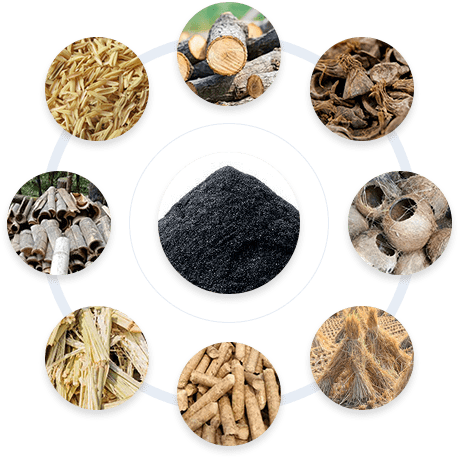
Biomass continuous drum carbonization machine is to process coconut shells, apricot shells, hemp stalks, sawdust, wood chips, rice husk, bamboo, eucalyptus, fungus residue, medicine residue, furfural residue, coffee residue, palm shells, peanut shells, walnut shell, It is an ideal equipment for dry distillation, anaerobic carbonization and high carbonization rate of carbonized wood materials such as sunflower husks (particles below 15mm in volume) under high-temperature conditions in the carbonization machine. The finished charcoal can be made into various shapes to meet the different needs of the market.
Dingli Continuous Charcoal Machine adopts new technology, avoiding the shortcomings of traditional carbonization equipment. At the same time, it has the advantages of 24 hours of continuous production, labor-saving, high output, low energy consumption, and a high degree of automation. It is suitable for large-scale production and has a high carbonization rate, energy saving, environmental protection, and high-efficiency advantages. welcome to your online inquiry.
In Southeast Asia, Africa, and South America, biomass resources are abundant, but stable and efficient processing equipment is relatively scarce. Due to its stable operation and simple maintenance, the continuous carbonization machine is gradually becomin
In the process of biomass carbonization projects moving from pilot projects to large-scale operations, equipment selection plays a decisive role. Continuous carbonization machines, with their continuous production capabilities and scalability, have become
The Malaysia EFB Pellet Carbonization Project has officially entered the production stage, delivering a stable processing capacity of 2 tons per hour. The project aims to provide a professional solution for the conversion of EFB pellets into biomass charc
Empty fruit bunches (EFB) have a high fiber content and large volume, making traditional processing methods often inefficient. The EFB continuous carbonization equipment solves this problem through continuous operation, enabling the efficient processing o