Focus on carbon equipment
Focus on carbon equipment


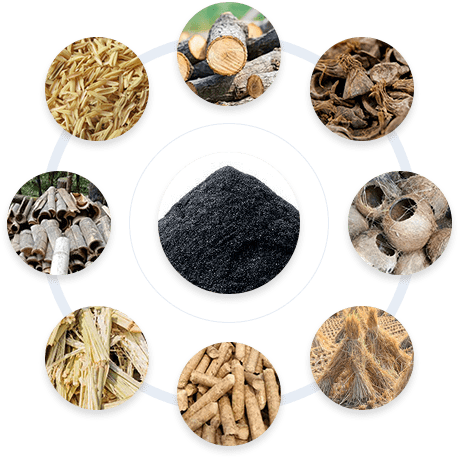
A carbonizer is a device that heats and decomposes biomass materials (such as wood, straw, fruit shells, etc.) in an oxygen-free or low-oxygen environment to generate charcoal, combustible gas and liquid. Its core principle is to use high-temperature pyrolysis to allow volatiles in biomass materials to escape, leaving solid charcoal.

The main functions of the carbonizer include:
1. Production of biochar: used for soil improvement, fertilizer, industrial raw materials, etc.
2. Energy production: the generated combustible gas and liquid can be used as fuel.
3. Waste treatment: convert agricultural and forestry waste into useful resources to reduce environmental pollution.
4. Reduce carbon emissions: Compared with direct combustion, the carbonization process has lower carbon emissions, which helps to mitigate climate change.
The main application areas of the carbonizer are:
• Agriculture: biochar is used to improve soil fertility.
• Industry: as activated carbon, metallurgical reducing agent, etc.
• Energy: provide renewable energy.
• Environmental protection: treat organic waste and reduce pollution.
Summary:
Carbonizer produces biochar, combustible gas and liquid by pyrolyzing biomass materials. It is widely used in agriculture, industry, energy and environmental protection fields, with both economic and environmental benefits.
In Southeast Asia, Africa, and South America, biomass resources are abundant, but stable and efficient processing equipment is relatively scarce. Due to its stable operation and simple maintenance, the continuous carbonization machine is gradually becomin
In the process of biomass carbonization projects moving from pilot projects to large-scale operations, equipment selection plays a decisive role. Continuous carbonization machines, with their continuous production capabilities and scalability, have become
The Malaysia EFB Pellet Carbonization Project has officially entered the production stage, delivering a stable processing capacity of 2 tons per hour. The project aims to provide a professional solution for the conversion of EFB pellets into biomass charc
Empty fruit bunches (EFB) have a high fiber content and large volume, making traditional processing methods often inefficient. The EFB continuous carbonization equipment solves this problem through continuous operation, enabling the efficient processing o