Focus on carbon equipment
Focus on carbon equipment


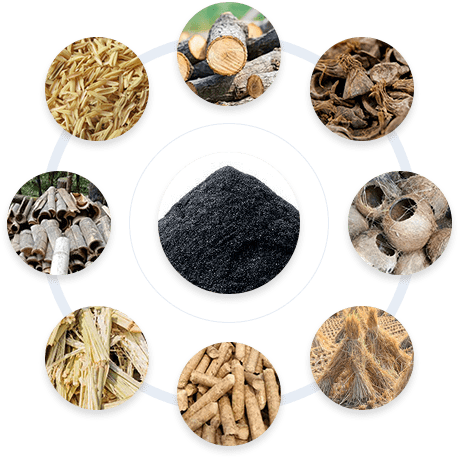
The working principle of the betel nut shell charcoal machine is mainly based on the process of converting biomass raw materials such as betel nut shells into charcoal. The following are the detailed steps of the betel nut shell charcoal machine:
1. Raw material preparation
Raw material collection: Collect betel nut shells as raw materials.
Pretreatment: Preliminary cleaning of betel nut shells to remove impurities.
2. Crushing and drying
Crushing: Feed the betel nut shells into the crusher and crush them into fine particles or powders, usually with a particle size of less than 10mm. This step is to increase the surface area of the raw materials for subsequent drying and molding.
Drying: Feed the crushed betel nut shell particles into the dryer and dry them with hot air or other heat sources to reduce their moisture content to a certain level (usually within 12%). Drying is a key step to ensure the smooth progress of the subsequent molding and carbonization process.
3. Molding
Rod making: The dried betel nut shell particles are fed into the rod making machine. The rod making machine uses the principle of high temperature and high pressure to squeeze fine particles into a rod-shaped solid with a certain density and strength, namely the raw carbon rod. This step is one of the core links of the charcoal machine.

4. Carbonization
Carbonization: The formed raw carbon rod is sent to the carbonization furnace for carbonization. The high temperature environment in the carbonization furnace causes a series of physical and chemical reactions between the volatile matter and the fixed carbon in the raw carbon rod, and finally converts into charcoal. The carbonization process needs to control conditions such as temperature, time and ventilation to ensure the quality and output of charcoal.
5. Finished product processing
Cooling and packaging: The carbonized charcoal needs to be cooled to reduce its temperature and make it more stable. The cooled charcoal can be packaged and stored for subsequent sales and use.
In Southeast Asia, Africa, and South America, biomass resources are abundant, but stable and efficient processing equipment is relatively scarce. Due to its stable operation and simple maintenance, the continuous carbonization machine is gradually becomin
In the process of biomass carbonization projects moving from pilot projects to large-scale operations, equipment selection plays a decisive role. Continuous carbonization machines, with their continuous production capabilities and scalability, have become
The Malaysia EFB Pellet Carbonization Project has officially entered the production stage, delivering a stable processing capacity of 2 tons per hour. The project aims to provide a professional solution for the conversion of EFB pellets into biomass charc
Empty fruit bunches (EFB) have a high fiber content and large volume, making traditional processing methods often inefficient. The EFB continuous carbonization equipment solves this problem through continuous operation, enabling the efficient processing o